Under-sink reverse osmosis
Will an RO system fit under my sink?
Measure the cabinet, check the faucet opening, and find out which systems work with the plumbing and power you already have.
Check your cabinet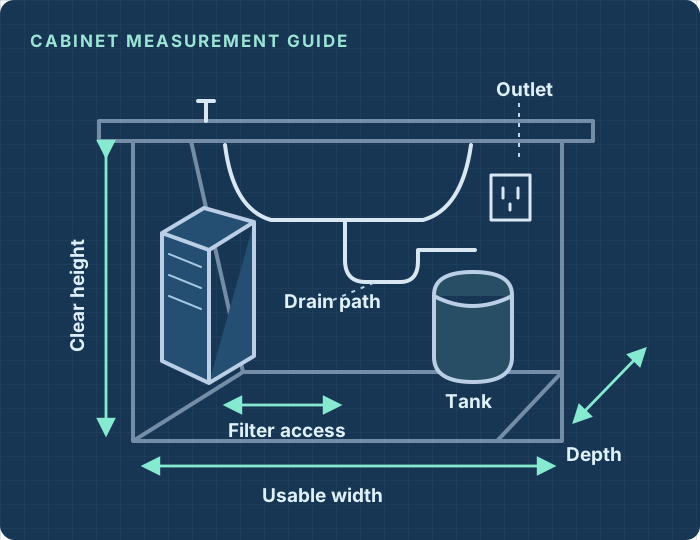
Start with what’s under the sink
Specifications and prices checked for U.S. products.
- Measure each usable space. Record front-to-back depth, side-to-side width and height below the bowl. Check the door opening and obstructions such as the disposal, trap, valves and pull-out bins. A tank may need its own separate spot.
- Leave access for service. Check tubing bends and travel to remove filters. Waterdrop’s front filters need straight-out access and its manual advises keeping the tower off the cabinet wall. Aquasana needs working access to its twist-out cartridges and separate remineralizer. APEC needs room to remove its vertical filter housings and reach the tank valve. The dimensions below describe the equipment. Ask the manufacturer or installer to confirm service space for your proposed orientation, including fittings.
- Check the cold-water feed and drain. All three use a cold feed and a reject-water path to a drain. Check for a reachable shutoff and confirm feed pressure, thread compatibility, drain access and local air-gap or backflow requirements with an installer.
- Look for a dedicated faucet opening. A compatible unused accessory opening may avoid countertop drilling. Measure above and below the opening and check the faucet’s secure mounting and tubing. The AQ-SFRO2 guide discusses compatible dedicated faucets and code-dependent air-gap arrangements. G3P800 includes a wired smart faucet. Verify before planning to reuse an older faucet.
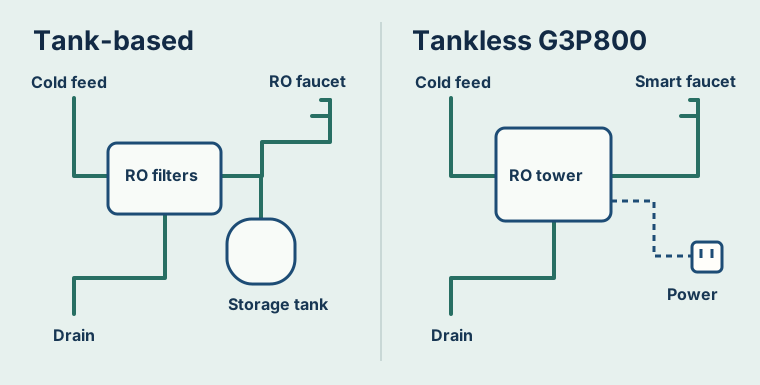
- Check for an always-on outlet for G3P800. Its pump, controls and smart faucet require the supplied power connection. The standard SmartFlow and ROES-50 configurations use feed pressure and a storage tank. Ask a qualified electrician about a safe receptacle if the only outlet is switched or inaccessible.
Get permission before modifying a rental. For stone drilling, new electrical work, uncertain plumbing or local air-gap requirements, get a qualified installer’s assessment before ordering.
Compare a clear cabinet space
Enter the clear depth, width and height for one part at a time.
Passing this check does not guarantee installation compatibility. The tool compares one part’s published dimensions in the orientation shown. Before ordering, check the door opening and obstructions, room for all parts and filter changes, mounting, tubing and fittings, cold-water feed, drain and air gap, faucet, and power where needed. Follow the exact model’s instructions and ask a qualified installer if any requirement is uncertain.
Equipment length is aligned with cabinet depth. An exact match leaves zero clearance on that axis.
Tank or tankless?
The SmartFlow and ROES-50 split the cabinet footprint between a filter assembly and a pressurized tank. The G3P800 uses a single powered tower and still needs a suitable drain, dedicated faucet and service access.